Zochrot means remember.
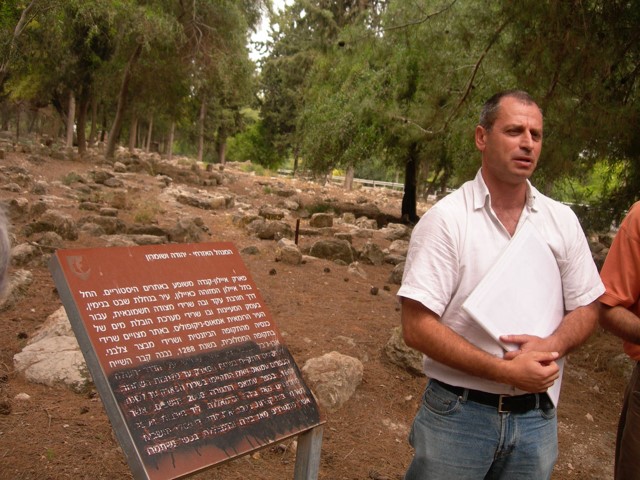
Our group walking through a national park near Jerusalem with Eitan Bronstein, a rugged-looking middle-aged Israeli unquestioningly joined the Israeli army at eighteen. Years later, he learned a more complex version of history and became the director of Zochrot, an Israeli organization whose members erect handmade signs in Arabic and Hebrew naming Palestinian villages destroyed in 1948. These alternative signs are typically blackened within hours. Official park signs marked a Roman bathhouse, Crusader fortress, and buildings from the Hellenic and Ottoman past. Without Eitan, we would not have understood the significance of the almond trees shading scattered stone blocks that had once been a mosque, a school, and an unmarked cemetery. The reality of occupation suddenly invaded the peaceful forest.
I took this photo in 1998. Canada Park was named for Canadian donors unaware their money was being used to plant trees on the ruins of three Palestinian villages destroyed in 1967—Imwas, Yalu, and Beit Nuba. The five thousand villagers who lived there became refugees. These villages, located at the strategic Latrun Junction, were suspected of supporting Palestinians in 1948 when Israeli fighters failed to secure the corridor between Tel Aviv and Jerusalem, leaving the fledgling country with a narrow bottleneck of land that was finally conquered in 1967. Nothing indicated that we were standing on the Palestinian side of the 1948 Armistice Line, also known as the Green Line, the internationally recognized border between Israel and Jordan.
Eitan explained that the Jewish National Fund (JNF), established in 1901, bought land all over Palestine. Early Zionists planted pine trees chosen for their ability to grow quickly and tall––unlike the slow-growing, fruit bearing indigenous almond and olive trees. In 2004, the legal center for Arab minority rights in Israel, challenged the prohibition of Arab-Israeli citizens from living on land owned by the Jewish National Fund. They lost. The Israeli Supreme Court decreed that the land was the collective property of Jewish people around the world.
“Kids across America went door to door holding blue and white tin cans, asking for donations to plant trees in Israel,” explained Eitan.
“I was one of those kids,” I chimed in. “I believed we were helping to make the desert bloom.”
 Through My Eyes
Leave a comment