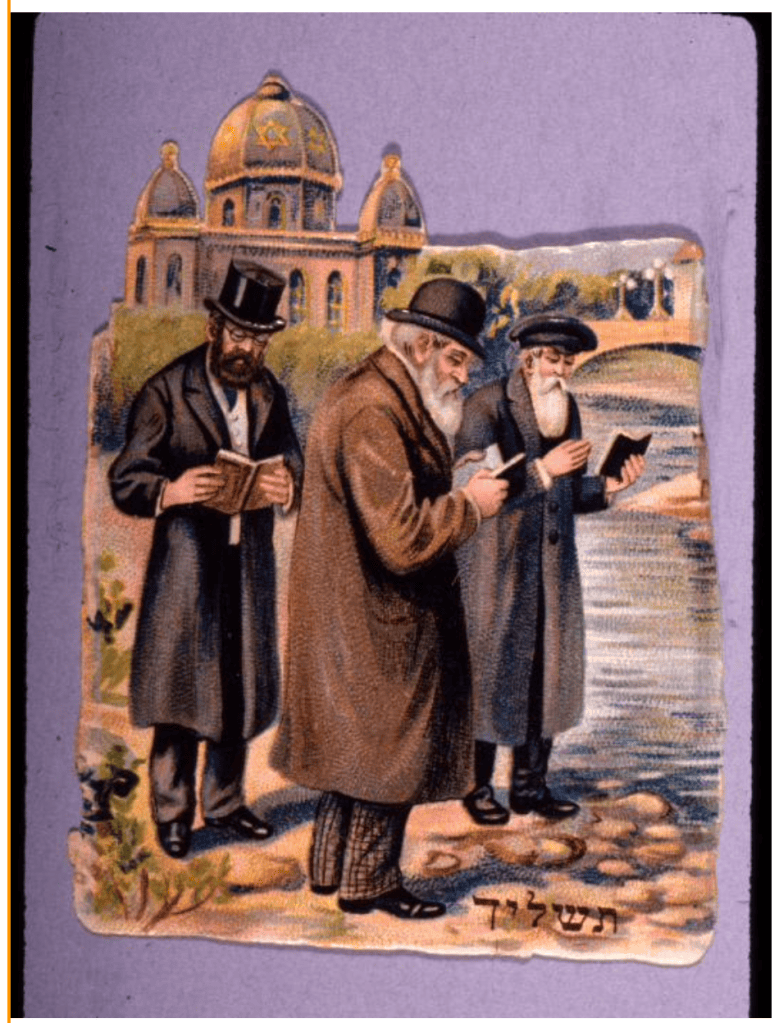
Tashlich: late 19th century Europe
Iris Keltz
The sound of the shofar being blown on Rosh Hashanah echoed well beyond the synagogue walls in suburban Queens where I grew up. From the park across the street, I listened to the trills of the ram’s horn and imagined being a shepherd guarding her flock. I imagined. But the Judaism I grew up with seemed disconnected from the earth.
In the late sixties, I lived at New Buffalo Commune in Arroyo Hondo whose symbol—the buffalo— was about sustenance, survival, community, and love for the earth. I learned about irrigation there. It was fascinating to watch water flow from the mother ditch to rows of corn, beans and squash. Distant clouds teasingly walked across the desert floor. Sometimes they watered our gardens. I knew where on the horizon the sun would set on the winter and summer solstice. We soaked in hot springs serenaded by canyon wrens flying between the rock cliffs.
When Tashlich became popular in the alternative Jewish community, I thought it was a response to the earth traditions in northern New Mexico. But this ritual is old, and may have originated in medieval Germany during the 14th century, or even earlier. The ritual, practiced during Rosh Hashanah offers an opportunity to symbolically cast away our sins. Preferably it is performed by a river, lake, sea or ocean. Kurdistani Jews immersed themselves in the Tigris or Euphrates River. In places that lack flowing water the ritual can be performed by a pond, cistern, or Mikvah. The practice is derived from a Biblical passage (Micah 7:18) “You will cast all sins into the depths of the sea.” The date of Rosh Hashanah depends on the Jewish lunar calendar. In our part of the world, it comes during the fall harvest, when we put gardens to rest.
This year Rosh Hashanah begins on the eve of September 11th, the 25th anniversary of the deadliest terrorist attack on the US since Pearl Harbor. Both events changed the course of history and will never be forgotten.
Shortly before my mother died at 108 years, she surprised me with a Tashlich story from 1941. My parents, Max and Janette, shared a love of everything Jewish. On the second day of Rosh Hashanah entire congregations of Jews, including the rabbi, would gather in Caldwell Plaza in Brooklyn and walk to the center of the bridge to perform Tashlich. Janette and Max were among them. Everyone said prayers of confession before casting their sins into the East River by throwing pieces of challah into the churning waters below. This ceremony clearly connects us with our ancestors.
In Taos, our Jewish community meets by the Rio Grande. We write sins on paper, mixed them up, and read them aloud before casting bread into the never ending current. It’s a community purge. But this year we are experiencing unprecedented drought. There’s not enough water in the river to wash away our sins. Green algae chokes the current. The monsoon rains have not come. We look to the clouds and pray for rain to soak the parched earth.
When I toss my bread into the water this year, I will give gratitude for each precious droplet. I will pray the bread finds its way into hungry bellies and all thirsts are quenched. As the human race skates perilously close to moral disintegration and catastrophe, I am worried. I am not okay. I remember my mother who was challenged to welcome a Palestinian husband for her only daughter. It was 1967, shortly after the 6-Day War. Mom welcomed the stranger into our family with an outstretched hand. If we all could do that, we would not be witnessing a genocide and ethnic cleansing happening in real time. That is the hope. And that is the heartbreak.
 Through My Eyes
Leave a comment